## E-MARS: Enhanced MARS Assembler
[MARS][1] is a lightweight interactive development environment (IDE) for programming in MIPS assembly language, developed by [Pete Sanderson][4] (programming) and [Ken Vollmar][5], intended for educational-level use with Patterson and Hennessy's Computer Organization and Design.
**EMARS** (this repo) is Azalea's enhanced version of MARS.
## Changes from Mars 4.5:
### EMARS 4.7
* Switched to Gradle build system with Kotlin support
* Added `--open` command-line option to open a file on start
* Added **Keyboard++**: Enhanced keyboard events
* **Keyboard++** is still compatible with old keyboard's ASM code, even though it only repeats the last key down until the key is released.
* Refactored many classes in Kotlin
* A LOT of [optimizations](https://github.com/hykilpikonna/EMARS#optimizations)
## FAQ
**How to run:** Install Java JDK >11 and double-click on the jar.
**How to compile:** `gradle shadowJar`
## Modifications needed
1. To use **Bitmap Display++**, please add the following code at the end of each loop, after render but before sleep:
```asm
# Tell the display to update
lw $t8, ADDR_DISPLAY
li $t9, 1
sw $t9, 0($t8)
```
## Keyboard++
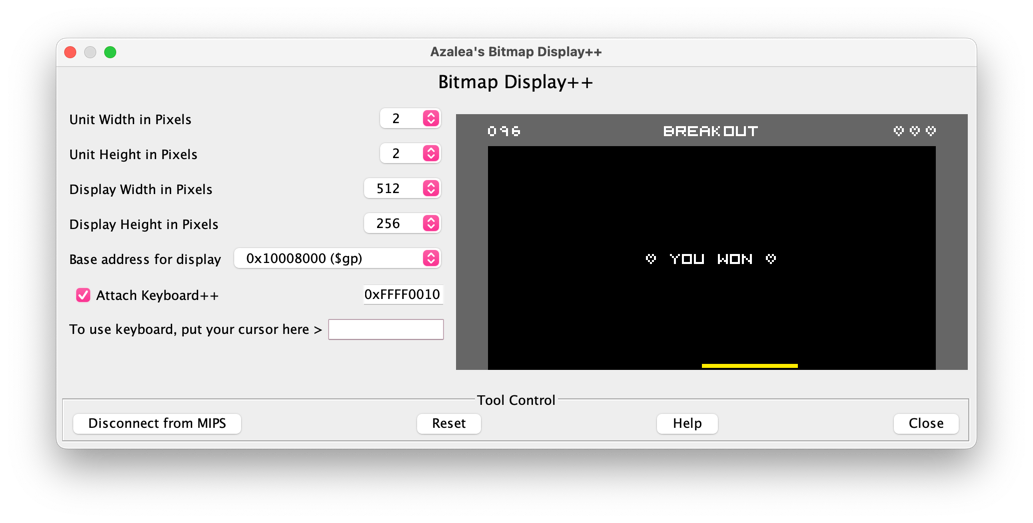
Mars' MMIO Keyboard can only send one key event at any given time, and key repeats are handled by the operating system running Java, which is very bad for controlling a game because of the delay and inconsistency introduced.
So I developed the enhanced **Keyboard++** with additional features:
* **14 simultaneous key events!**
(MARS 4.5 can read only 1 key at a time)
* **Fine control of separate key-down and key-up events**
(MARS 4.5 can only read keys typed)
* **Use 2-byte key code** instead of 1-byte ASCII char
(Non-character keys like arrows & F1-F12 can now be read)
* **Filter out system key repeats**
(Pressing a key for longer will not repeat any event)
* **Use "clear byte"** to indicate if the events should be cleared
(MARS 4.5 clears the key byte whenever it is read)
### Specification

From the initial address, the first 4 words (16 bytes) represents key-down events (when a key is first pressed). The next 4 words (16 bytes) represent key-up events.
For each event type, the 0x0 byte stores an unsigned integer `n`, ranging from `0` to `7`, representing how many key events are pooled.
The 0x1 byte tells the keyboard handler whether the events are read by your MIPS program and should be reset. If 1 is written to the 1st byte, then all keys in the current event cycle will be cleared to 0.
From the 0x2 byte to the 0xF byte stores `n` unsigned 2-byte key codes received, in chronological order. (e.g. the 0x2 half-word stores the first key that's pressed after the last reset). The keycodes are the same with the keycodes used in Java's KeyEvent class. I've attached a list of keycodes extracted from the class below.
### Sample
Here's a sample MIPS code that reads events from Keyboard++:
Example MIPS Program using Keyboard++
```asm
.data
# The addresses of Keyboard++
ADDR_KEY_DOWN: .word 0xffff0010
ADDR_KEY_UP: .word 0xffff0020
# Example variables
PAUSED: .word 1
KEY_MOVE_DIRECTION: .byte 0
.text
# """
# read_keyboard()
#
# Listen to keyboard events
# """
read_keyboard:
# Save items onto the stack: ra, s0, s1
sw $ra, -4($sp)
sw $s0, -8($sp)
sw $s1, -12($sp)
addi $sp, $sp, -12
# 1. Check for key down event
lw $s0, ADDR_KEY_DOWN
lbu $s1, 0($s0)
beq $s1, 0, key_down_none
# In a loop, read the keys that are down (pressed)
# while (s1 > 0)
while_1_0:
sub $t9, $s1, $zero
blez $t9, while_done_1_0
# {
# Move offset to the next half-word
addiu $s0, $s0, 2
# Read half-word keycode
lhu $t2, 0($s0)
# if (t2 == 0x51): Q, quit
bne $t2, 0x51, else_2_0
li $v0, 10
syscall
else_2_0:
# if (t2 == 0x20): Space, lauch ball
bne $t2, 0x20, else_2_2
# if (PAUSED == 1)
lw $t9, PAUSED
bne $t9, 1, else_2_2
jal launch
else_2_2:
# if (t2 == 0x25): Left arrow, set flag that we're moving left
bne $t2, 0x25, else_2_3
li $t9, -1
sw $t9, KEY_MOVE_DIRECTION
else_2_3:
# if (t2 == 0x27): Right arrow, set flag that we're moving right
bne $t2, 0x27, else_2_4
li $t9, 1
sw $t9, KEY_MOVE_DIRECTION
else_2_4:
# Next iteration
addi $s1, $s1, -1
# }
j while_1_0
while_done_1_0:
# When we're done, write 1 to offset 1 to clear events
lw $s0, ADDR_KEY_DOWN
li $s1, 1
sb $s1, 1($s0)
key_down_none:
# 2. Check for key up event
lw $s0, ADDR_KEY_UP
lbu $s1, 0($s0)
beq $s1, 0, key_up_none
# In a loop, read the keys that are up (released)
# while (s1 > 0)
while_1_1:
sub $t9, $s1, $zero
blez $t9, while_done_1_1
# {
addiu $s0, $s0, 2
lhu $t2, 0($s0)
# Left arrow released, unset flag
# if (t2 == 0x25 && KEY_MOVE_DIRECTION == -1)
bne $t2, 0x25, else_2_5
lw $t9, KEY_MOVE_DIRECTION
bne $t9, -1, else_2_5
li $t9, 0
sw $t9, KEY_MOVE_DIRECTION
else_2_5:
# Right arrow released, unset flag
# if (t2 == 0x27 && KEY_MOVE_DIRECTION == 1)
bne $t2, 0x27, else_2_6
lw $t9, KEY_MOVE_DIRECTION
bne $t9, 1, else_2_6
li $t9, 0
sw $t9, KEY_MOVE_DIRECTION
else_2_6:
addi $s1, $s1, -1
# }
j while_1_1
while_done_1_1:
# When we're done, write 1 to offset 1 to clear events
lw $s0, ADDR_KEY_UP
li $s1, 1
sb $s1, 1($s0)
key_up_none:
# Retrieve items from the stack: ra, s0, s1
lw $s1, 0($sp)
lw $s0, 4($sp)
lw $ra, 8($sp)
addi $sp, $sp, 12
jr $ra
```
### List of Keycodes
List of all key codes
```python
ENTER = 0xA
BACK_SPACE = 0x8
VK_TAB = 0x9
# Regex used to extract keys: (?<=VK_)([A-Z0-9_]+) += +?([0-9A-Fa-fx]+)(?=;)
CANCEL = 0x03
CLEAR = 0x0C
SHIFT = 0x10
CONTROL = 0x11
ALT = 0x12
PAUSE = 0x13
CAPS_LOCK = 0x14
ESCAPE = 0x1B
SPACE = 0x20
PAGE_UP = 0x21
PAGE_DOWN = 0x22
END = 0x23
HOME = 0x24
LEFT = 0x25
UP = 0x26
RIGHT = 0x27
DOWN = 0x28
COMMA = 0x2C
MINUS = 0x2D
PERIOD = 0x2E
SLASH = 0x2F
0 = 0x30
1 = 0x31
2 = 0x32
3 = 0x33
4 = 0x34
5 = 0x35
6 = 0x36
7 = 0x37
8 = 0x38
9 = 0x39
SEMICOLON = 0x3B
EQUALS = 0x3D
A = 0x41
B = 0x42
C = 0x43
D = 0x44
E = 0x45
F = 0x46
G = 0x47
H = 0x48
I = 0x49
J = 0x4A
K = 0x4B
L = 0x4C
M = 0x4D
N = 0x4E
O = 0x4F
P = 0x50
Q = 0x51
R = 0x52
S = 0x53
T = 0x54
U = 0x55
V = 0x56
W = 0x57
X = 0x58
Y = 0x59
Z = 0x5A
OPEN_BRACKET = 0x5B
BACK_SLASH = 0x5C
CLOSE_BRACKET = 0x5D
NUMPAD0 = 0x60
NUMPAD1 = 0x61
NUMPAD2 = 0x62
NUMPAD3 = 0x63
NUMPAD4 = 0x64
NUMPAD5 = 0x65
NUMPAD6 = 0x66
NUMPAD7 = 0x67
NUMPAD8 = 0x68
NUMPAD9 = 0x69
MULTIPLY = 0x6A
ADD = 0x6B
SEPARATER = 0x6C
SUBTRACT = 0x6D
DECIMAL = 0x6E
DIVIDE = 0x6F
DELETE = 0x7F
NUM_LOCK = 0x90
SCROLL_LOCK = 0x91
F1 = 0x70
F2 = 0x71
F3 = 0x72
F4 = 0x73
F5 = 0x74
F6 = 0x75
F7 = 0x76
F8 = 0x77
F9 = 0x78
F10 = 0x79
F11 = 0x7A
F12 = 0x7B
F13 = 0xF000
F14 = 0xF001
F15 = 0xF002
F16 = 0xF003
F17 = 0xF004
F18 = 0xF005
F19 = 0xF006
F20 = 0xF007
F21 = 0xF008
F22 = 0xF009
F23 = 0xF00A
F24 = 0xF00B
PRINTSCREEN = 0x9A
INSERT = 0x9B
HELP = 0x9C
META = 0x9D
BACK_QUOTE = 0xC0
QUOTE = 0xDE
KP_UP = 0xE0
KP_DOWN = 0xE1
KP_LEFT = 0xE2
KP_RIGHT = 0xE3
DEAD_GRAVE = 0x80
DEAD_ACUTE = 0x81
DEAD_CIRCUMFLEX = 0x82
DEAD_TILDE = 0x83
DEAD_MACRON = 0x84
DEAD_BREVE = 0x85
DEAD_ABOVEDOT = 0x86
DEAD_DIAERESIS = 0x87
DEAD_ABOVERING = 0x88
DEAD_DOUBLEACUTE = 0x89
DEAD_CARON = 0x8a
DEAD_CEDILLA = 0x8b
DEAD_OGONEK = 0x8c
DEAD_IOTA = 0x8d
DEAD_VOICED_SOUND = 0x8e
DEAD_SEMIVOICED_SOUND = 0x8f
AMPERSAND = 0x96
ASTERISK = 0x97
QUOTEDBL = 0x98
LESS = 0x99
GREATER = 0xa0
BRACELEFT = 0xa1
BRACERIGHT = 0xa2
AT = 0x0200
COLON = 0x0201
CIRCUMFLEX = 0x0202
DOLLAR = 0x0203
EURO_SIGN = 0x0204
EXCLAMATION_MARK = 0x0205
INVERTED_EXCLAMATION_MARK = 0x0206
LEFT_PARENTHESIS = 0x0207
NUMBER_SIGN = 0x0208
PLUS = 0x0209
RIGHT_PARENTHESIS = 0x020A
UNDERSCORE = 0x020B
WINDOWS = 0x020C
CONTEXT_MENU = 0x020D
FINAL = 0x0018
CONVERT = 0x001C
NONCONVERT = 0x001D
ACCEPT = 0x001E
MODECHANGE = 0x001F
KANA = 0x0015
KANJI = 0x0019
ALPHANUMERIC = 0x00F0
KATAKANA = 0x00F1
HIRAGANA = 0x00F2
FULL_WIDTH = 0x00F3
HALF_WIDTH = 0x00F4
ROMAN_CHARACTERS = 0x00F5
ALL_CANDIDATES = 0x0100
PREVIOUS_CANDIDATE = 0x0101
CODE_INPUT = 0x0102
JAPANESE_KATAKANA = 0x0103
JAPANESE_HIRAGANA = 0x0104
JAPANESE_ROMAN = 0x0105
KANA_LOCK = 0x0106
INPUT_METHOD_ON_OFF = 0x0107
CUT = 0xFFD1
COPY = 0xFFCD
PASTE = 0xFFCF
UNDO = 0xFFCB
AGAIN = 0xFFC9
FIND = 0xFFD0
PROPS = 0xFFCA
STOP = 0xFFC8
COMPOSE = 0xFF20
ALT_GRAPH = 0xFF7E
BEGIN = 0xFF58
UNDEFINED = 0x0
```
## Optimizations
In MARS, the BitmapDisplay [re-draws the entire canvas](https://github.com/thomasrussellmurphy/MARS_Assembler/blob/c21dd72e8d2e4a51eb24e276c3f39ef1789148f2/mars/tools/BitmapDisplay.java#L496) instead of only the updated pixels whenever any memory address is updated. This makes updating the display very very very slow, taking 12% of all run time.

For example, if I loop through the display and change every pixel in my assembly code, the original running time of h∗w will now take h2∗w2, making it take around one second for each update.
Since I can’t easily draw one pixel on update without manual manipulation of AWT Graphics, I changed it so that it treats bit 0 of the memory display as an “update bit,” and only re-draw the screen when the MIPS program sets bit 0 to 1.
After optimizing for this, it runs faster but still not enough for the animation to be smooth. Then, I discovered that most of the running time is used by the backstepper and notifying observers for changes in registers and memory:

By default, MARS will store backstep register file copies each time a register is updated, which takes a lot of time since registers are updated very frequently. So I removed backstepping when the execution speed limit is not set. MARS also notifies all memory observers when a program statement instruction is read from memory, which I also removed because nothing uses the notification from reading program statements.
## License
[MIT][2]. Chech the [LICENSE][3] file. All the credits go to the original developers.
[1]: http://courses.missouristate.edu/KenVollmar/MARS/index.htm
[2]: http://www.opensource.org/licenses/mit-license.html
[3]: https://github.com/adolphenom/MARS_Assembler/blob/master/LICENSE
[4]: http://faculty.otterbein.edu/PSanderson/
[5]: http://courses.missouristate.edu/KenVollmar/
[6]: http://courses.missouristate.edu/KenVollmar/MARS/download.htm
[7]: http://courses.missouristate.edu/KenVollmar/MARS/Help/MarsHelpIntro.html
[8]: http://twitter.com/aesptux